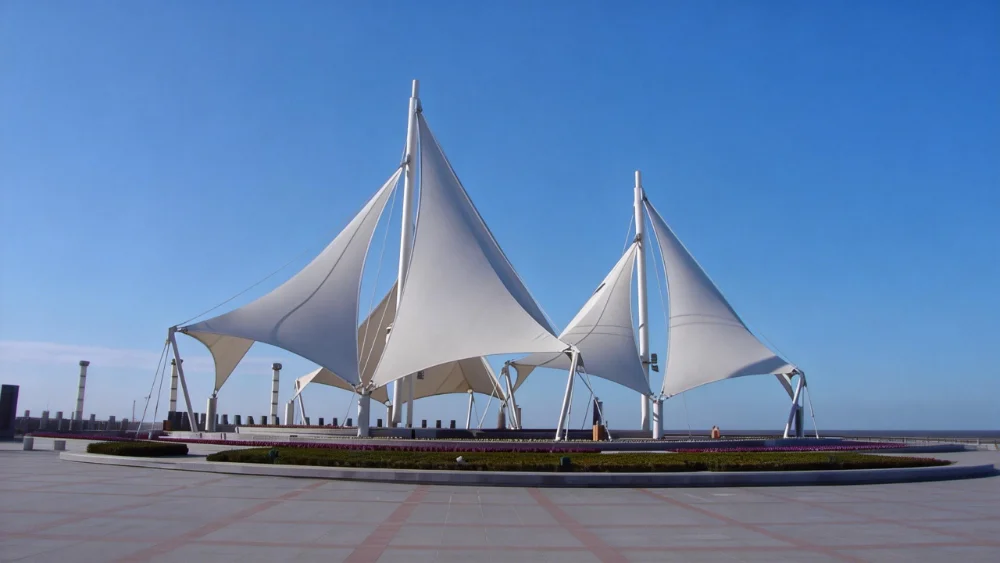
Membrane canopy maintenance begins before construction. Although tensile canopies look light, open and simple, the finished structure still needs to be inspected, cleaned, drained, adjusted and eventually repaired. If those activities are considered only after handover, owners can face expensive access arrangements, inaccessible gutters and avoidable closures.
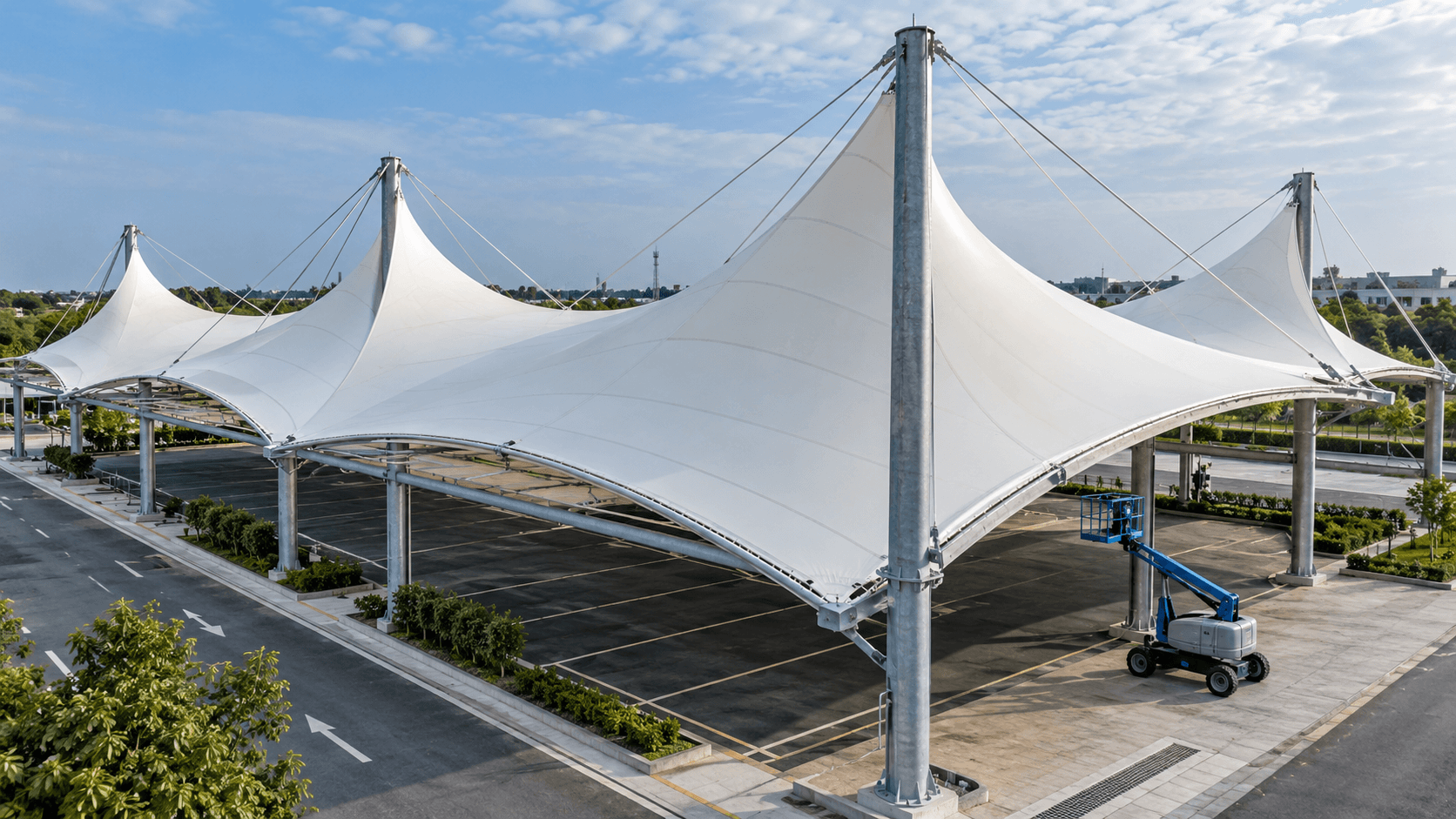
This article focuses on the maintenance decisions that belong in the early design stage. It does not repeat structural load design, material selection or factory quality-control procedures covered elsewhere; it looks specifically at how to keep a finished membrane roof serviceable over its working life.
Maintenance starts with the access strategy
A safe access plan should be established before support positions and roof edges are finalized. The right method depends on the canopy height, plan area, surrounding traffic, available ground space and local safety regulations.
Ask these questions during design:
- How will a technician reach the membrane surface, edge clamps, gutters, lights and other mounted equipment?
- Can a mobile elevating work platform reach every service area without blocking an entrance or live traffic lane?
- Are permanent access routes, anchor points or walkways required?
- Is the site exposed to wind that would make temporary access equipment unsafe?
- Can maintenance take place without removing large membrane areas?
The access method should be documented in the project drawings. A canopy that can only be reached by closing a major road, occupying a loading bay or using a crane should be identified early, while the geometry can still be changed.
Separate routine inspection from major intervention
A practical maintenance plan distinguishes between frequent visual checks and less frequent technical inspections.
Routine checks can focus on:
- Visible tears, abrasion or loose edge details
- Excessive movement or flapping in the membrane
- Water ponding or blocked drainage
- Corrosion at exposed steel and connections
- Loose clamps, cable fittings or fixings
- Damage caused by vehicles, tools or falling objects
- Signs of water entering the building at interfaces
More detailed inspections may require access equipment and a qualified engineer. These inspections can examine connection tightness, coating condition, membrane prestress and the condition of anchors or supporting structures.
The exact frequency should follow the material supplier’s guidance, local requirements, site exposure and the consequences of failure. A coastal, industrial or high-traffic site may require more frequent checks than a sheltered internal installation.
Put inspection points where people can actually see them
Important connections should not be permanently concealed by trim, cladding, equipment cabinets or building finishes unless those covers can be removed safely.
During detailing, identify:
- Primary cable and membrane edge connections
- High and low roof points
- Gutter outlets and drainage transitions
- Interfaces with walls, columns and existing roofs
- Equipment supports and cable penetrations
- Likely repair or replacement zones
Small inspection openings, removable covers or accessible fixing points may avoid the need to dismantle finished details later. Any opening must still preserve weatherproofing, structural performance and fire or acoustic requirements.
Make drainage maintainable, not only hydraulically adequate
A gutter can handle the calculated rainfall and still become a maintenance problem if it cannot be reached, cleaned or inspected.
The drainage strategy should consider:
- Safe access to gutters and downpipes
- Ability to remove leaves, grit and debris
- Inspection of outlets and joints
- Controlled overflow during a blockage
- Discharge locations that do not create hazards below
- Prevention of water tracking into concealed building cavities
Long internal gutters and outlets hidden above ceilings can be particularly difficult to service. Where they cannot be avoided, provide compliant access and a clear maintenance procedure. The existing membrane canopy drainage guide covers hydraulic planning in more detail; this article focuses on keeping those drainage components reachable after installation.
Select equipment that supports future cleaning
Cleaning resources should match the site and the actual height of the canopy.
For many PVC-coated polyester membranes, a simple hose, soft brush and neutral cleaning agent may be appropriate, provided the membrane manufacturer’s written guidance is followed. Abrasive pads, aggressive solvents and high-pressure jets that can damage seams or coatings should be avoided unless specifically approved.
Designers should consider:
- How water will be supplied at roof level
- How runoff from cleaning will be controlled
- Whether waste can fall onto pedestrians, roads or equipment
- Access to sheltered or heavily soiled areas
- The handling of snow, sand or pollutants specific to the location
- Protection of adjacent surfaces during cleaning
A white or light-coloured membrane can visibly mark in polluted environments. That does not necessarily make it unsuitable, but the cleaning regime and interval should be estimated honestly during procurement.
Plan for panel replacement and local repair
All membrane systems should be assumed to need some form of local repair during their service life. The aim is to make that repair practical without removing the entire roof.
Useful design measures include:
- Dividing large surfaces into logical membrane panels
- Keeping panel and seam identification consistent with fabrication drawings
- Providing enough access to edge tensioning and connection hardware
- Avoiding continuous equipment runs that isolate a panel from removal routes
- Recording material type, coating, colour and production references
- Retaining replacement or repair material where practical
For a permanent structure, the project owner should receive a repair strategy explaining:
- How small surface repairs are made
- Which personnel or approved contractors may carry them out
- How a panel can be isolated and retensioned
- What temporary weather protection may be required
- Which details must not be modified on site
A locally repairable roof is usually more resilient than a design in which every defect threatens a complete re-cover.
Coordinate lighting, cameras and other mounted equipment
Routine maintenance often includes systems that are not part of the membrane itself. Lighting, cameras, antennas, sensors, emergency equipment and EV-charging infrastructure can all create service demands.
Confirm:
- Whether each item can be reached without loading the membrane
- How brackets transfer loads into the steel structure
- Whether cable penetrations can be re-sealed after service
- How a failed device can be replaced without damaging adjacent membrane panels
- Whether maintenance activities create access restrictions below
- Who is responsible for electrical isolation and reconnection
Equipment installed by separate contractors should be coordinated with the membrane geometry. A small camera bracket added later can become a significant leak or corrosion risk if it is not designed as part of the assembly.
Consider the lifecycle of the supporting steel
Membrane maintenance includes its support system. Inspections should cover steel coatings, galvanising, welds, bolts, cables and connections, even where these components are not immediately visible.
Maintenance planning should record:
- Specified coating or galvanising system
- Permitted cleaning and inspection methods
- Access to connection hardware
- Touch-up requirements after damage or service work
- Areas where moisture, salt or process emissions accumulate
On exposed sites, corrosion at connections can become more significant than visible coating wear. The existing guide to coastal membrane canopy corrosion protection explains the broader durability and connection strategy.
Prepare the maintenance information at handover
The design team may understand how the canopy was assembled, but future operators will not necessarily have that knowledge. A handover pack should make the structure understandable without returning to the original design team.
Recommended documents include:
- Approved as-built drawings
- Membrane material and coating data
- Steel coating and connection schedule
- Panel and component identification
- Allowable cleaning products and methods
- Inspection checklist and reporting template
- Safe access and exclusion-zone requirements
- Repair and replacement procedure
- Contact details for technical support
- Warranty conditions and maintenance obligations
Photographs of concealed connections before closure can be especially useful. They help future inspectors understand what lies behind finished details.
Build a practical inspection schedule
The exact schedule belongs in the project-specific maintenance plan, but a useful starting point is:
- After handover: confirm that the installed geometry, drainage and connections match the approved information.
- First seasonal change: check how the roof performs under the site’s actual wind, rain, heat or snow conditions.
- Before predictable severe-weather periods: clear drainage and inspect loose or damaged details.
- Annually: review the membrane, steelwork, cable connections, fixings and interfaces.
- After exceptional events: inspect following a severe storm, vehicle impact, fire, construction work or other unusual loading.
Access requirements vary, so safety should be planned rather than improvised at the time of an inspection.
Common maintenance problems created by design
Several recurring problems can often be traced back to early choices:
- Gutters placed where no maintenance equipment can reach them
- Equipment mounted on the membrane instead of the structural frame
- Continuous membrane panels that make local replacement impractical
- Hidden connections with no removable access cover
- Cleaning carried out with pressure or chemicals that damage coatings
- No component labels, drawings or material records after handover
- Temporary access equipment unable to work around live operations
- Roof geometry that encourages debris accumulation at inaccessible low points
These issues are easier to resolve during design than after the site is occupied.
Maintenance is part of total project value
A membrane roof can remain visually elegant and structurally efficient for many years when it is designed as an operable asset rather than a finished picture. Safe access, clear drainage, replaceable panels and good handover information all reduce the uncertainty of future ownership.
The most useful design review therefore covers not only how the canopy will be built, but also how someone will stand next to it safely, inspect it, clean it, remove debris and repair it in the years after completion.
If you are planning a custom tensile membrane structure, include the expected cleaning regime, access constraints and maintenance responsibilities in the early project discussion. Send your project details to Timi for a project-specific review.