Drainage is one of the details that decides whether an outdoor membrane canopy works well after installation. A canopy may have a clean shape, suitable membrane material and good visual effect, but if rainwater is not guided properly, the covered area can still become difficult to use during heavy rain.
For tensile membrane canopies, drainage is not a separate accessory added at the end. It is connected with the membrane form, high points, low points, valley lines, steel frame direction, column layout, gutter position, downpipe route, site paving and the way people or vehicles move under the canopy.
This is especially important for commercial entrances, membrane carports, grandstands, toll stations, walkways, public plazas and outdoor shade structures. Before requesting a quotation, buyers should prepare basic site drawings, dimensions, photos, project location and drainage expectations. These details help the supplier review the canopy as a real site condition, not just as a roof area.
Drainage Should Be Considered Before the Canopy Shape Is Fixed
One of the common mistakes in outdoor canopy projects is confirming the canopy shape too early. The drawing may look balanced, but the water path may not be practical. Once the steel layout, membrane cutting pattern and connection points are fixed, changing drainage later can affect the whole structure.
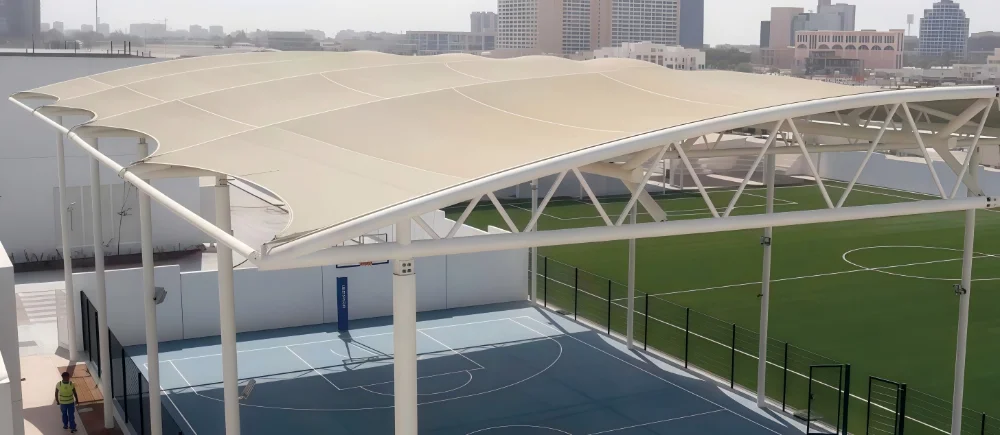
In a membrane canopy, water does not simply run in one straight direction. It follows the geometry of the stretched surface. High points raise the membrane and create tension. Low points collect water. Curved edges, valley lines and boundary beams guide the direction of flow.
A practical drainage plan should answer several questions at the beginning:
- Where are the high points and low points of the membrane surface?
- Will water move toward a controlled gutter or discharge freely from the edge?
- Can downpipes be placed near columns or hidden in the structure?
- Where will water finally go after leaving the canopy?
- Will the discharge point affect doors, parking spaces, traffic lanes, seats or walkways?
- Can the gutter and downpipe be cleaned after installation?
If these questions are not discussed before fabrication, the project may need redesign, additional site work or visible drainage changes after installation.
How Membrane Geometry Controls Water Flow
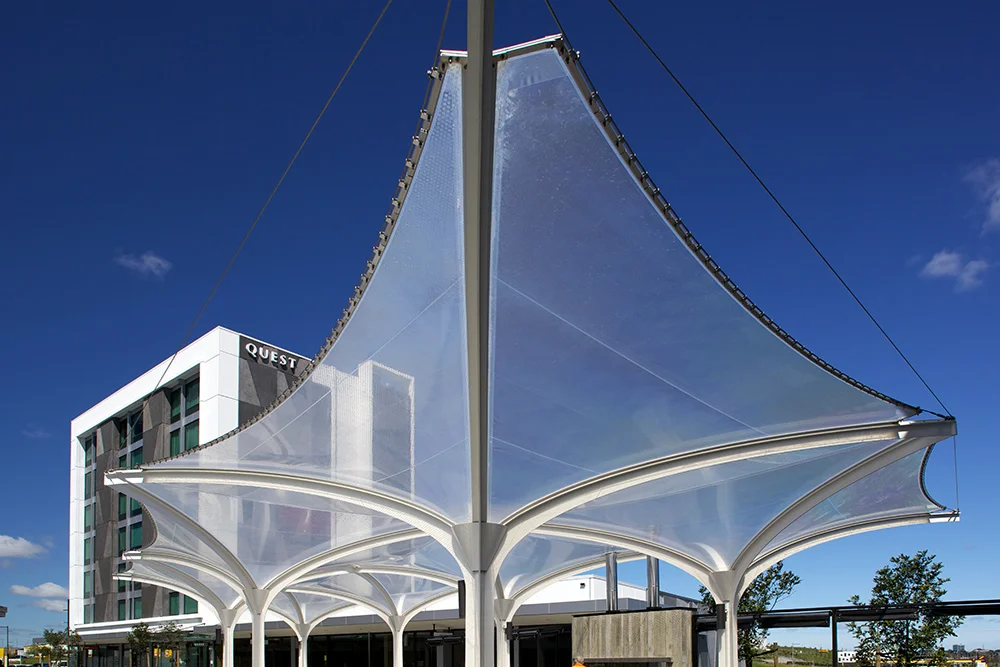
A tensile membrane canopy usually includes a combination of high points, low points, ridges, valleys and edge curves. This geometry gives the canopy its architectural form, but it also controls rainwater movement.
The low point is not just a visual detail. It is often where water concentrates. If the low point is above a doorway, vehicle door-opening area, toll booth, seating row or public walkway, the canopy may create a daily-use problem even if the structure is technically complete.
| Drainage Element | Project Role | What Can Go Wrong |
|---|---|---|
| High Point | Creates membrane form, tension direction and visual height | If poorly placed, it may push water toward an inconvenient low area |
| Low Point | Collects water and often determines gutter or downpipe location | Water may fall near entrances, vehicles, seats, stairs or equipment |
| Valley Line | Guides water along a natural flow path on the membrane surface | Uncontrolled valley lines may create water concentration or staining |
| Membrane Edge | Defines where water leaves the canopy perimeter | Unplanned runoff may cause splashing, wet paving or facade staining |
| Column Position | Often provides a practical route for downpipes | If columns are not aligned with drainage points, pipes may become exposed or awkward |
During early design review, the supplier should understand not only the covered area, but also the preferred direction of water discharge. A simple arrow marked on a site plan can often prevent many later misunderstandings.
Drainage and Column Layout Must Be Reviewed Together
Column layout is usually discussed for structural reasons, but it also affects drainage. In many membrane canopy projects, downpipes are placed beside or inside columns because this keeps the drainage route cleaner and easier to support.
However, column positions cannot be decided only by drainage. They also need to match span, steel frame direction, foundation location, vehicle movement, pedestrian access and architectural appearance. A good layout balances these requirements instead of treating drainage and structure as two separate systems.
For example, in a membrane carport, repeated columns may provide a natural rhythm for gutters and downpipes. In a commercial entrance canopy, columns must avoid the main pedestrian route, but they may still need to carry drainage pipes. In a toll station canopy, columns must stay away from active lanes, and drainage pipes must also avoid booths, signs, cameras and electrical equipment.
The same support decisions that affect clearance and structure also affect water discharge, which is why span and column layout in tensile membrane structures should be reviewed before the drainage route is finalized.
Do Not Ignore the Ground After Water Leaves the Canopy
A canopy drainage plan is not complete when water reaches the gutter or downpipe. The next question is where the water goes on the ground.
In retrofit projects, the problem is often not the membrane surface itself, but whether the existing paving slope and nearby drains can accept the collected water. If the paving slopes back toward the building, even a well-shaped canopy may still send water toward doors or wall joints. If the nearest drain is too far away, the downpipe may discharge onto a walkway or parking area.
Before confirming the drainage route, the following site conditions should be checked:
- Existing floor drain or trench drain locations
- Paving slope around the canopy area
- Door thresholds and low facade areas
- Glass wall joints and waterproofing-sensitive areas
- Underground pipes, cables or drainage lines near column bases
- Areas where water splash may affect users
- Whether the drainage point can be accessed for cleaning
This is one reason why site photos alone are not always enough. Basic dimensions and a simple site drainage sketch can make the quotation and early review much more useful.
Application-Specific Drainage Priorities
Different canopy applications have different drainage risks. The drainage solution for a carport should not be copied directly to a commercial entrance or grandstand without checking how the space is used.
| Application | Main Drainage Priority | Areas to Avoid |
|---|---|---|
| Commercial Entrance Canopy | Keep the main doorway, waiting area and facade edge dry | Door thresholds, glass walls, customer queues, signage and lighting |
| Membrane Carport | Prevent water from falling where drivers open doors or pedestrians walk between cars | Vehicle door areas, parking bay edges, driveways and turning paths |
| Grandstand Canopy | Protect seating rows, aisles and exits during rain | Spectator seats, stairs, emergency routes and lower walkways |
| Toll Station Canopy | Move water away from operational lanes, booths and equipment | Toll booths, cameras, electrical boxes, traffic signs and active lanes |
| Walkway Canopy | Keep pedestrian circulation safe and reduce wet or slippery zones | Ramps, stairs, main paths, building entrances and gathering points |
| Park or Plaza Shade Structure | Control runoff without affecting public activity zones | Benches, landscaped paths, paved plazas and children’s activity areas |
For outdoor projects where membrane form, column layout, material and drainage route must be reviewed together, a custom membrane structure should be discussed with drawings, site dimensions and discharge expectations before quotation.
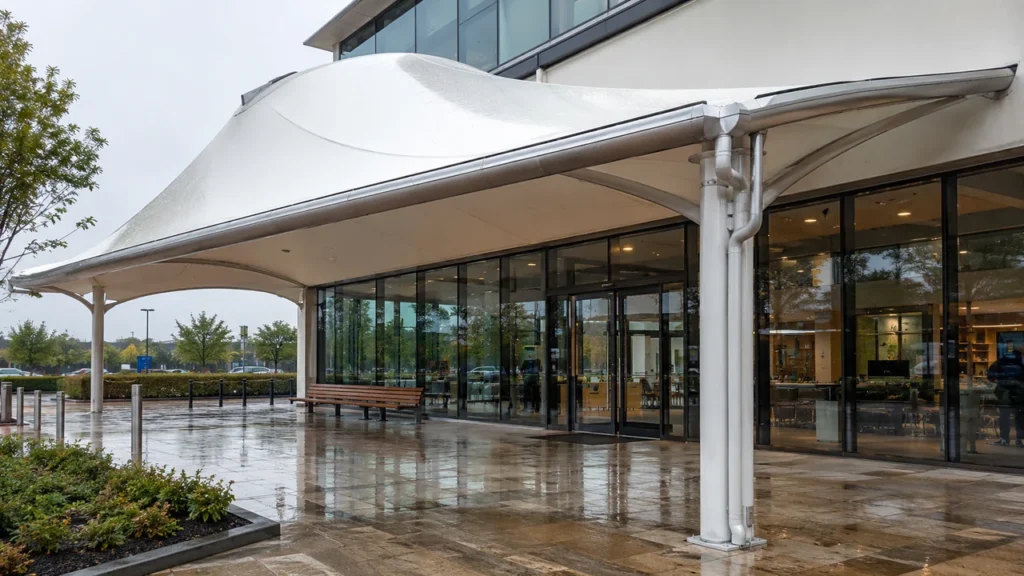
Commercial Entrance Canopies: Avoid Doorway Splash and Facade Problems
Entrance canopies require careful drainage because the covered area is used every day by visitors, customers, staff or guests. If water falls directly at the front edge of the doorway, the canopy may still create wet flooring and splashback during heavy rain.
Important details include entrance width, projection depth, door position, glass facade layout, signboard location, lighting, existing paving slope and nearby drain position. The drainage route should avoid door thresholds, automatic doors, facade joints and waiting areas.
For existing buildings, the wall condition should also be checked. If the canopy is connected to the facade, rainwater should not be directed toward window frames, cladding joints or areas without proper waterproofing. If the canopy is column-supported, downpipe positions should be coordinated with column bases and site paving.
In a commercial entrance canopy, drainage should be checked together with doorway position, facade protection, lighting and customer movement instead of being added after the canopy shape is approved.
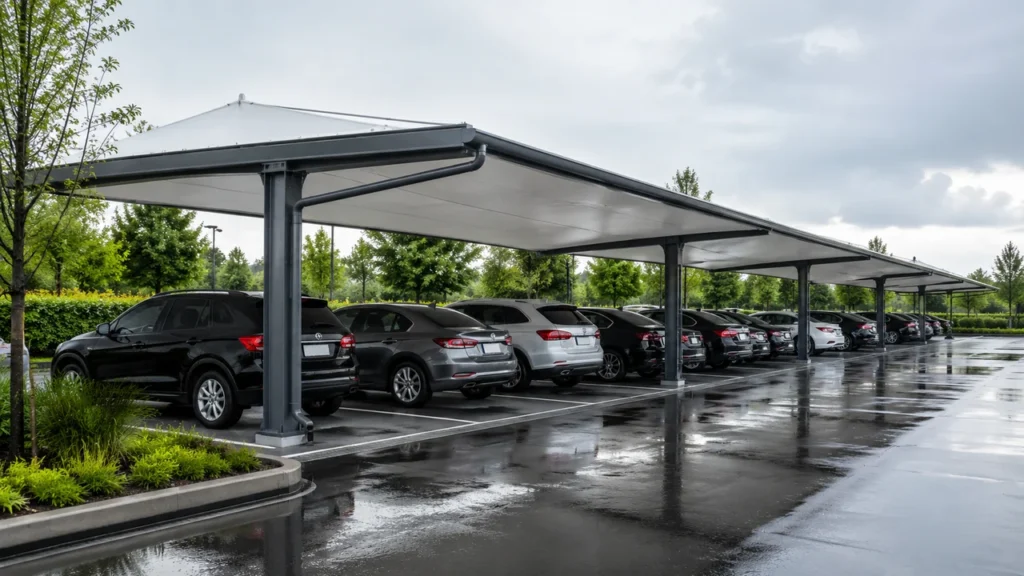
Membrane Carports: Drainage Should Follow Parking Use
In membrane carport projects, drainage should follow parking logic. Water should not fall where drivers open doors, where people walk between vehicles or where cars turn into the parking bay.
A repeated carport layout often makes drainage easier because columns and canopy bays can form a regular system. Gutters can follow the low edge, and downpipes can be placed near selected columns. But the discharge point still needs to connect to a safe ground drainage route.
On many parking canopy projects, the first drawing shows only the total covered area. That is not enough. The layout should also show parking bay width, driveway direction, vehicle height, column position, pedestrian path and existing drain locations.
For a membrane structure carport, drainage should be planned around parking bays, vehicle doors, driveway movement and the location of site drains.
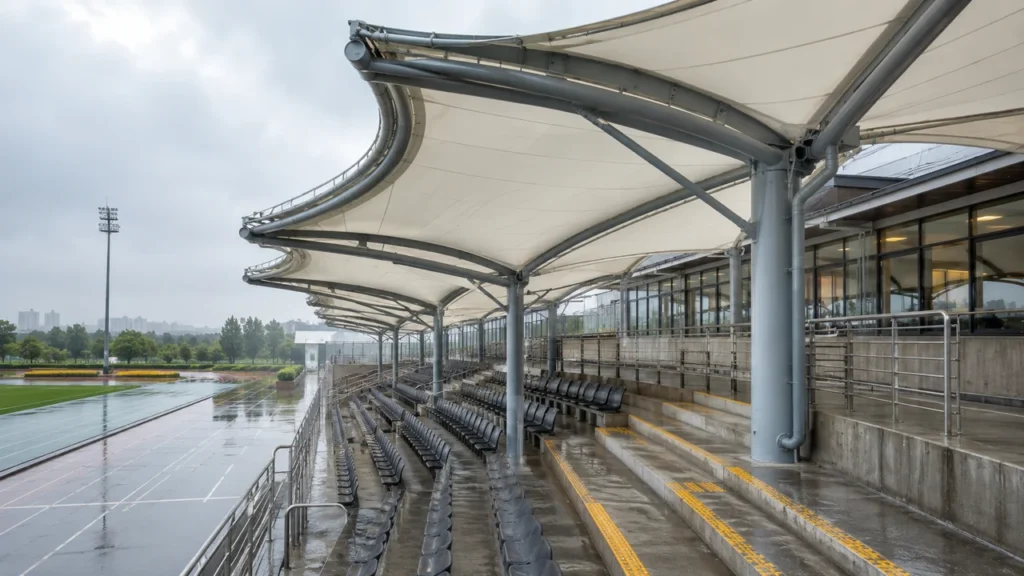
Grandstand Canopies: Keep Seats, Stairs and Exits Dry
Grandstand canopy drainage should be reviewed together with seating layout and spectator movement. The roof may cover the seats, but if water falls onto stairs, exits or lower walkways, the daily-use problem remains.
A wide grandstand canopy often has longer gutter lines and higher drainage points. The structure should guide water away from seating rows and circulation routes. Downpipes should not block aisles, emergency exits, railings, camera positions or maintenance access.
Because grandstand canopies often include lighting, speakers and other equipment, drainage components should also be coordinated with service access. Gutters and downpipes should remain inspectable after installation.
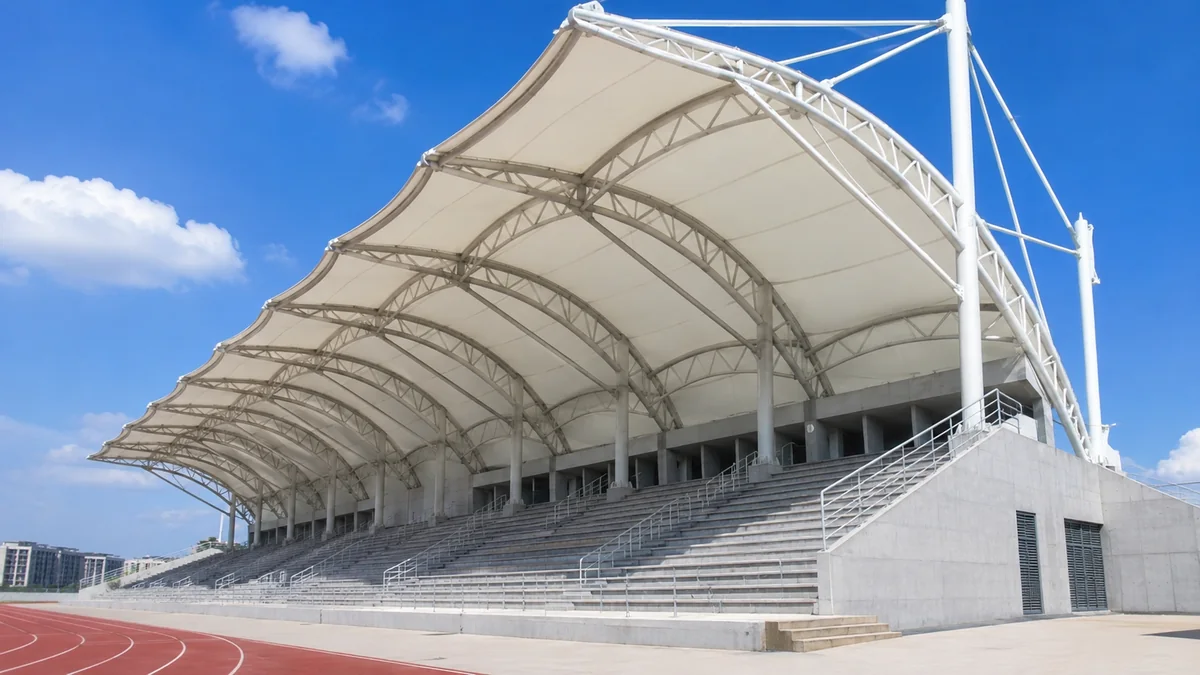
A grandstand membrane structure should keep water away from spectator seats, stairways, emergency routes and maintenance areas while preserving clear sightlines.
Toll Station Canopies: Drainage Is Also an Operational Safety Issue
Toll station and transport canopies require stricter drainage planning because the covered area includes moving vehicles, booths, traffic equipment and service personnel. Water discharge should not enter active lanes or collect near toll equipment.
Before confirming the canopy form, the project team should check lane width, booth position, camera location, sign visibility, lighting, electrical boxes, maintenance paths and vehicle clearance. Downpipes should be placed where they do not reduce traffic safety or block equipment access.
Drainage near toll stations is not only about user comfort. Poor discharge can create wet lane surfaces, affect equipment areas or make maintenance difficult. It is better to solve these details during early layout review than after the canopy is installed.
For toll plaza canopies and toll station roof structures, water discharge should avoid active lanes, booths, cameras, signs and electrical systems.
Gutters and Downpipes Should Be Easy to Maintain
A drainage system that works on the first day should also be serviceable after the canopy is in use. Leaves, dust, sand, membrane surface dirt and wind-blown debris may collect near gutters or low points. If these areas cannot be inspected or cleaned, water discharge may become less reliable over time.
Maintenance access should be considered together with appearance. Some projects prefer hidden drainage. Others accept exposed gutters and downpipes because they are easier to clean. The right choice depends on the project type, building style, maintenance ability and site environment.
| Drainage Detail | What to Confirm Before Production |
|---|---|
| Gutter Position | Whether the gutter follows the low edge, valley line or structural beam direction |
| Gutter Capacity Direction | Whether collected water can move toward the intended downpipe without overflow risk |
| Downpipe Route | Whether pipes can follow columns, be hidden in the structure or discharge visibly |
| Cleaning Access | Whether gutters, low points and downpipes can be inspected after installation |
| Discharge Point | Whether water connects to site drains or discharges safely away from users and equipment |
| Visual Effect | Whether drainage components affect the intended architectural appearance |
For export projects, gutter parts, downpipes and drainage accessories should be clearly identified in drawings, component labels and packing lists. This helps the local contractor understand how the drainage system should be assembled on site.
Local Climate Changes the Drainage Strategy
A canopy used mainly for sunshade does not face the same drainage conditions as a canopy in a heavy-rain area. Project location should be provided during early communication because climate affects both drainage planning and material selection.
In regions with frequent heavy rain, the water collection and discharge route should be reviewed more carefully. In coastal areas, gutter, fastener and steel surface protection may need additional attention. In snowy regions, snow accumulation and meltwater should be considered together with the structure. In dusty areas, gutters and low points may require easier cleaning access.
The manufacturer does not replace the local project engineer, but understanding the climate helps the supplier provide a more practical canopy direction during quotation and fabrication planning.
Drainage Mistakes That Often Appear After Installation
Some drainage problems are not obvious in renderings. They become visible only after the first heavy rain. The following issues are common in poorly coordinated canopy projects:
- The canopy edge discharges water directly in front of a doorway.
- The membrane low point sits above a pedestrian route, parking bay or seating row.
- Downpipes are added late and appear in awkward locations.
- Water falls onto glass facades, cladding joints or door thresholds.
- The site paving slope sends discharged water back toward the building.
- Gutters are difficult to access for cleaning.
- Drainage parts are missing from the quotation scope.
- The design is copied from another project with different rainfall and site layout.
- Water splash affects customers, parked vehicles, equipment or public walkways.
These mistakes can lead to complaints, extra site work, visible pipe changes or reduced usability. Most of them can be avoided if drainage is discussed before the membrane shape and steel frame are finalized.
Project Information Needed to Review Water Discharge
A useful drainage review does not always require complete engineering drawings at the first stage. However, the supplier needs enough information to understand how the canopy will work on the site.
| Information | Why It Matters |
|---|---|
| Application Type | Confirms whether the canopy is for an entrance, carport, grandstand, toll station, walkway or public space |
| Site Dimensions | Helps review canopy span, membrane slope, covered area and water flow direction |
| Drawings or Sketches | Shows facade, column position, building edge, site drainage route and project intention |
| Site Photos | Helps identify paving slope, existing drains, doors, obstacles and installation conditions |
| Project Location | Supports review of rainfall, wind, snow, coastal exposure and corrosion environment |
| Preferred Discharge Direction | Helps avoid entrances, traffic lanes, parking spaces, seating zones and equipment areas |
| Existing Drainage System | Shows whether canopy drainage can connect to site drains or needs separate discharge planning |
| Maintenance Requirements | Helps decide whether gutters and downpipes should be hidden, exposed or easier to access |
| Supply Scope | Clarifies whether gutters, downpipes, accessories, drawings, packing and installation support are included |
What to Prepare Before Asking for a Drainage Review
Before sending an inquiry, buyers can prepare a simple information package. It does not need to be perfect, but it should show the canopy area, site condition and preferred drainage direction.
- Mark the expected canopy area on a drawing or site photo.
- Show where entrances, traffic lanes, parking spaces, seats or walkways are located.
- Mark existing drains, trench drains or safe water discharge areas if known.
- Indicate where water should not fall.
- Provide the approximate canopy length, width, height and projection.
- Share photos of the building facade, paving slope and surrounding ground.
- Confirm whether downpipes can be placed near columns.
- Tell the supplier whether the site has heavy rain, snow, coastal humidity, dust or strong wind.
- Clarify whether drainage components should be hidden or easy to access for maintenance.
With this information, the supplier can provide a more realistic early review instead of only quoting by square meter.
Conclusion
Drainage planning is not a minor detail in outdoor membrane canopy projects. It affects membrane geometry, steel frame layout, column position, gutter design, downpipe route, site safety, maintenance and daily user experience.
A good membrane canopy should not only provide shade or architectural identity. It should guide rainwater away from doors, vehicles, seats, walkways, traffic lanes, equipment and public activity areas in a controlled and serviceable way.
Before requesting a quotation, buyers should prepare drawings, basic dimensions, site photos, project location, application details, preferred discharge direction and supply scope. This allows the canopy to be reviewed as a complete project rather than a simple roof surface.
For outdoor membrane canopies, carports, entrance structures, grandstands, toll station roofs and public shade projects, you can send drawings, dimensions and site drainage requirements through the project inquiry page for a practical review and quotation discussion.