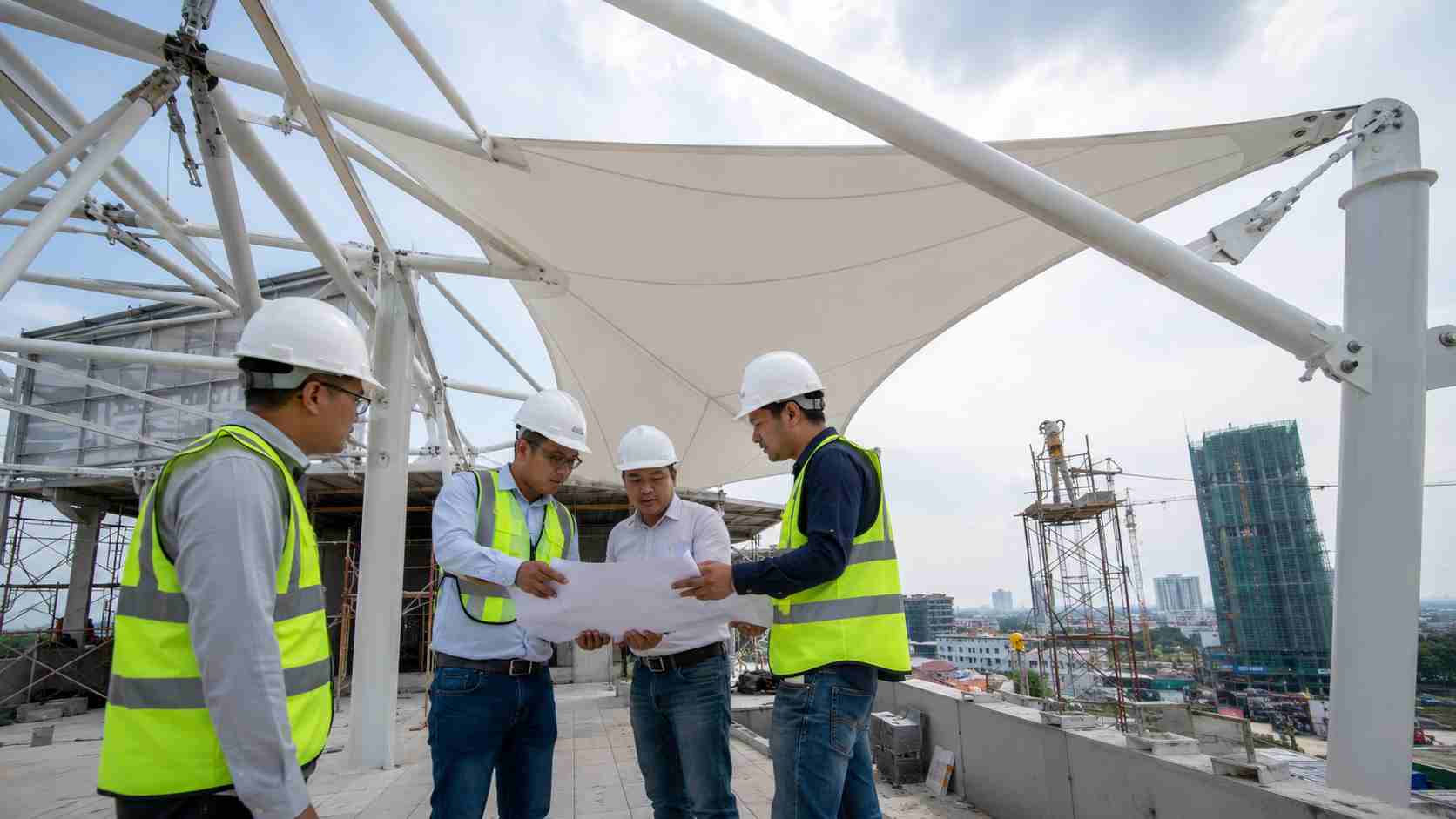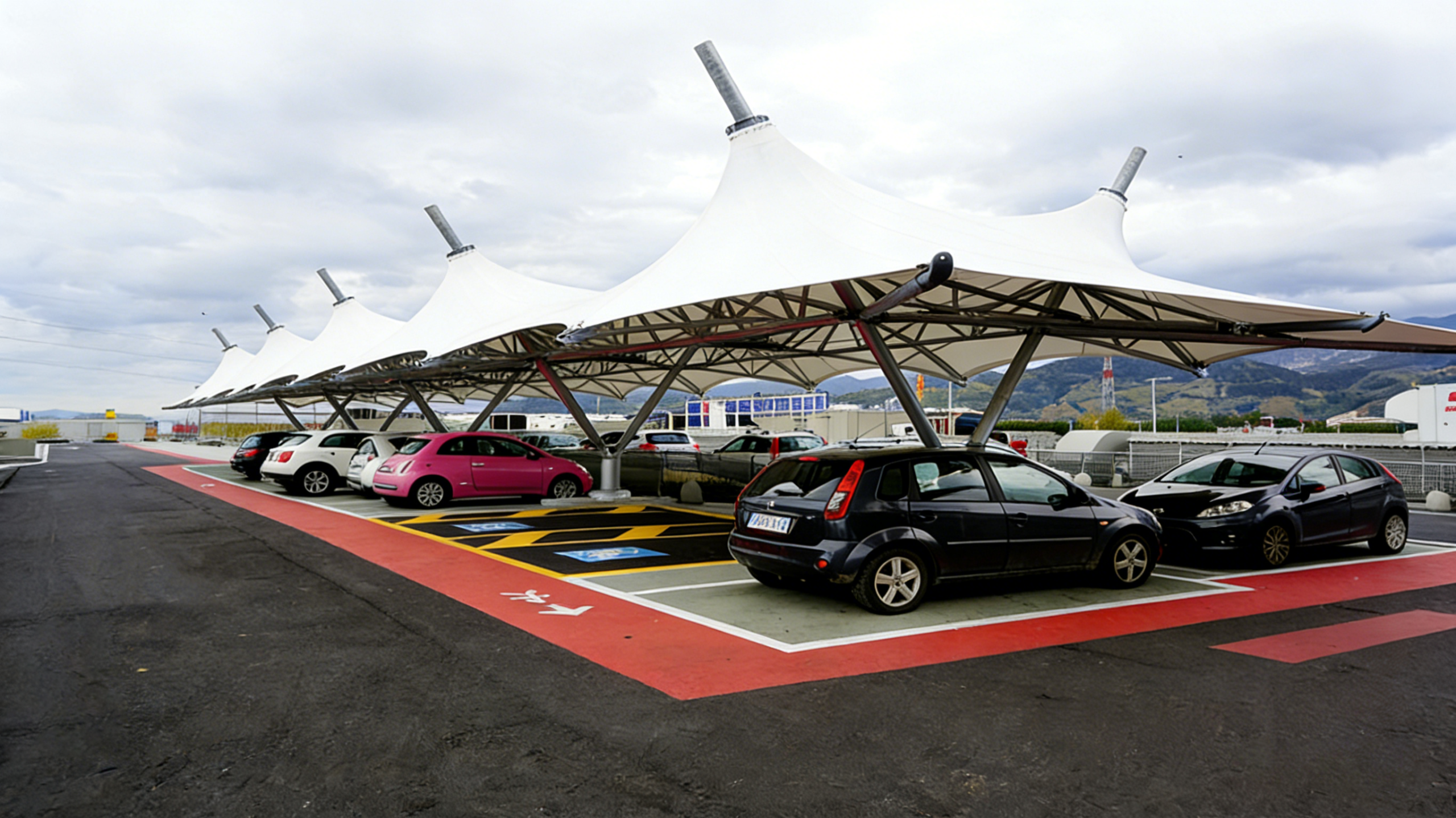
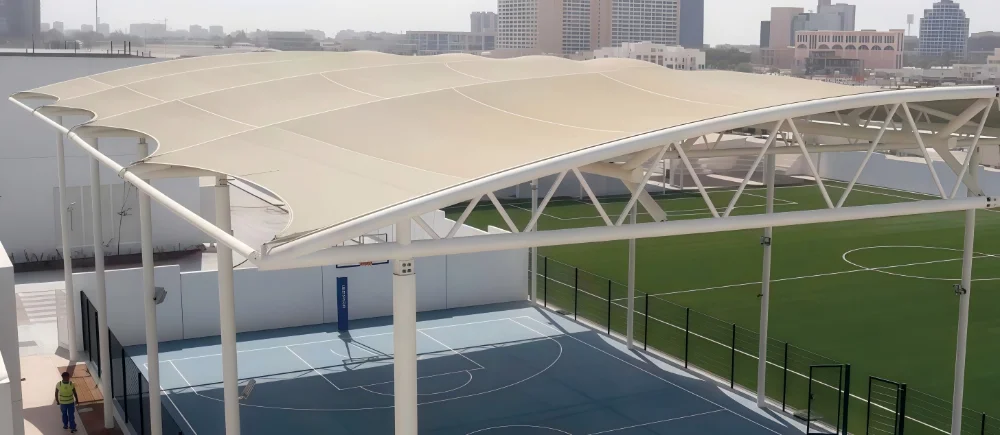
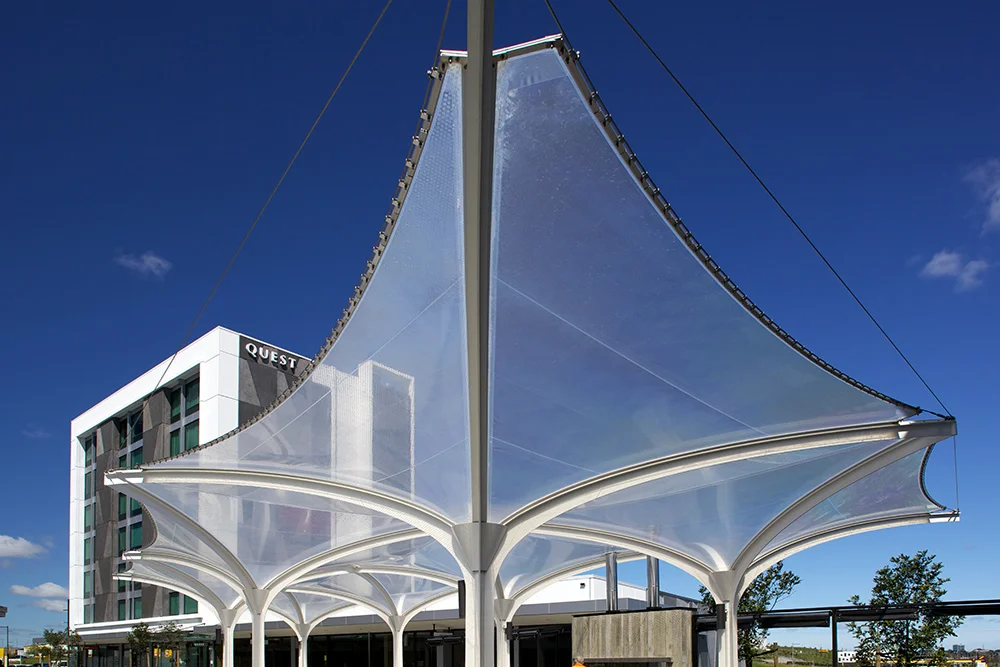
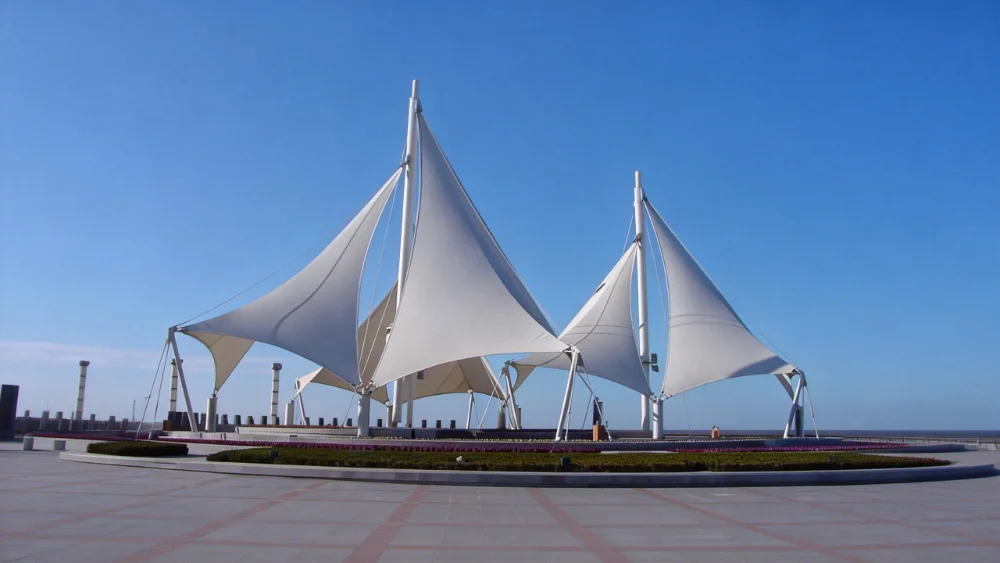
In a tensile membrane structure, the fabric surface is only the visible part of the system. The final performance of the project depends on how the membrane, steel frame, support points, foundation, drainage route and site movement work together. Among these factors, span and column layout are usually two of the earliest details that should be discussed before quotation.
Span affects how open the covered area can be. Column layout affects how people, vehicles, equipment and maintenance teams use the space after installation. If these two points are not reviewed carefully at the beginning, the project may look acceptable in a rendering but create problems on site, such as blocked entrances, poor drainage, difficult parking, interrupted sightlines or unexpected changes to the steel structure.
For custom membrane structures used in carports, commercial entrances, toll stations, grandstands, parks, plazas and transport facilities, span and column layout should be decided according to actual site conditions instead of copied from another project.
What Span Means in a Membrane Structure Project
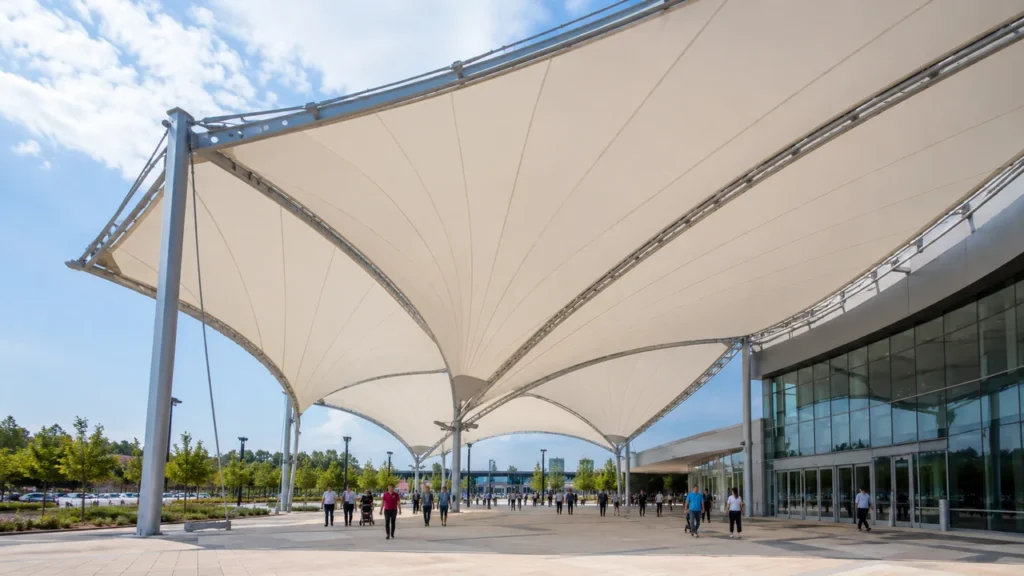
Span usually refers to the distance between the main support points of the structure. In tensile membrane projects, these support points may be steel columns, boundary beams, steel arches, wall connections, cable points or other structural supports.
A larger span can create a cleaner and more open space. This is often useful for public entrances, stadium seating areas, parking lots, transport facilities and toll lanes where visibility, clearance and movement are important. However, increasing the span also affects the steel frame, foundation, membrane tensioning, connection details, transportation and installation process.
A smaller span can make the structure easier to support, but it may require more columns. More columns are not always a problem, but they must be placed where they do not interfere with doors, vehicles, pedestrians, seating views, storefronts, signs or equipment.
This is why span should not be decided by appearance alone. It should be reviewed together with the site layout, required clearance, local climate, foundation condition and installation access.
Why Column Layout Is Not Just a Structural Detail
Column layout determines where the canopy touches the ground or connects to the building. In many projects, this detail has a direct effect on daily use.
For example, in a membrane carport, columns placed too close to the vehicle door area may make parking inconvenient. In a toll station canopy, columns must keep enough distance from active traffic lanes. In a grandstand canopy, support points should not block the spectator’s view. In a commercial entrance canopy, columns should not interfere with automatic doors, glass facades, logo signs, lighting, customer queues or emergency access.
The best column layout is not always the one with the fewest columns. A better approach is to find a layout that keeps the structure stable while preserving the function of the site.
How Different Applications Change the Span and Column Decision
The same tensile membrane form cannot be applied to every project. A canopy for a hotel entrance, a parking area and a stadium grandstand may all use membrane material, but the design logic is different.
| Project Type | Span Consideration | Column Layout Focus |
|---|---|---|
| Commercial Entrance Canopy | Entrance width, projection depth, facade connection and covered waiting area | Avoid blocking doors, signs, glass walls, lighting and pedestrian movement |
| Membrane Carport | Parking bay width, driveway clearance, vehicle height and repeated bay layout | Keep columns away from door-opening zones and vehicle turning paths |
| Toll Station Canopy | Lane width, vehicle clearance, toll booth coverage and equipment position | Maintain safe traffic clearance and avoid blocking signs, cameras or booths |
| Grandstand Canopy | Seating width, weather protection area, roof projection and viewing angle | Protect spectators without placing columns in key sightline areas |
| Park or Plaza Shade Structure | Activity area, walking route, landscape form and shaded coverage | Keep support points outside main gathering and circulation areas |
| Rooftop Canopy | Available fixing points, building load condition and wind uplift | Coordinate supports with roof structure, waterproofing, parapet and equipment |
For projects where the span, column position, material and supply scope are still being discussed, the custom membrane structure page can help buyers understand what information is usually needed before quotation.
Large Span Should Be Used for a Clear Reason
Many buyers prefer a large-span canopy because it creates an open space with fewer visible supports. In some projects, this is the right direction. Stadium canopies, toll station roofs, public plazas and transport terminals often benefit from fewer columns because the space needs clear movement, visibility or traffic flow.
However, a larger span is not automatically a better design. It can increase the demand on the steel frame, foundation, connection points and membrane tensioning system. It may also make fabrication, packing, shipping and installation more complex.
On retrofit projects, the issue is often not the membrane area itself, but whether the existing building, ground condition or available foundation locations can accept the required support layout. In these cases, reducing one column on the drawing may create a much larger structural problem later.
A practical design should balance open space, structural stability, drainage, installation sequence and project budget. The goal is not simply to remove columns, but to keep the covered area useful and buildable.
When More Columns Can Be the Better Choice
More columns are sometimes acceptable, especially when the project has a repeated layout. A long carport canopy may follow the rhythm of parking bays. A walkway canopy may use regular support points along the path. A park shade structure may use several columns as part of the landscape form.
The question is not whether the project has many or few columns. The real question is whether those columns are in the right places.
| Check Point | Why It Matters |
|---|---|
| Vehicle movement | Columns should not affect parking, turning, reversing or door opening |
| Pedestrian route | Support points should not block main walking paths, entrances or exits |
| Visibility | Columns should not block storefronts, signs, traffic signals, cameras or seating views |
| Foundation position | Column bases should avoid underground pipes, cables, drains or weak ground areas |
| Maintenance access | Lighting, membrane edges, gutters and drainage parts should remain accessible |
| Drainage route | Column positions may affect where gutters, downpipes or water discharge points can be placed |
How Span Influences Steel Frame and Membrane Tension
A tensile membrane structure works as a coordinated system. The membrane needs stable boundary conditions to maintain its shape and tension. The steel frame provides those boundary conditions, while the foundation transfers loads to the ground or building structure.
When the span increases, the steel members may need to carry higher loads. Boundary beams, arches, columns, connection plates and cable points may also need to be adjusted. The membrane cutting pattern and tensioning direction must be coordinated with these structural elements.
For outdoor projects, wind uplift, rainwater movement, sun exposure and temperature change also need to be considered. If span and tensioning are not coordinated properly, the canopy may be difficult to install or may not achieve the intended shape.
Material selection should also be reviewed together with structural planning. Buyers comparing PVDF, PTFE and ETFE options can refer to the article on choosing membrane materials for different project conditions.
Column Layout and Drainage Should Be Planned Together
Drainage is often treated as a later detail, but in membrane structure projects it is closely connected with span, support points and membrane shape.
A tensile membrane surface usually has high points and low points. Water naturally moves toward the lower areas. If those low points are not coordinated with gutters, downpipes or site drainage, rainwater may fall in the wrong place.
In a commercial entrance canopy, water should not discharge directly in front of the main doorway. In a toll station canopy, water should be kept away from booths, electrical equipment and active traffic lanes. In a grandstand canopy, drainage should not fall onto seating rows, stairs or exits. In a park or plaza canopy, water discharge should avoid main walking areas where slippery surfaces may become a problem.
Column locations are often used to hide or support downpipes, but this only works when drainage is considered before the steel layout is fixed. If columns are moved later, the drainage route may also need to be changed.
Carport Projects: Column Layout Follows Parking Logic
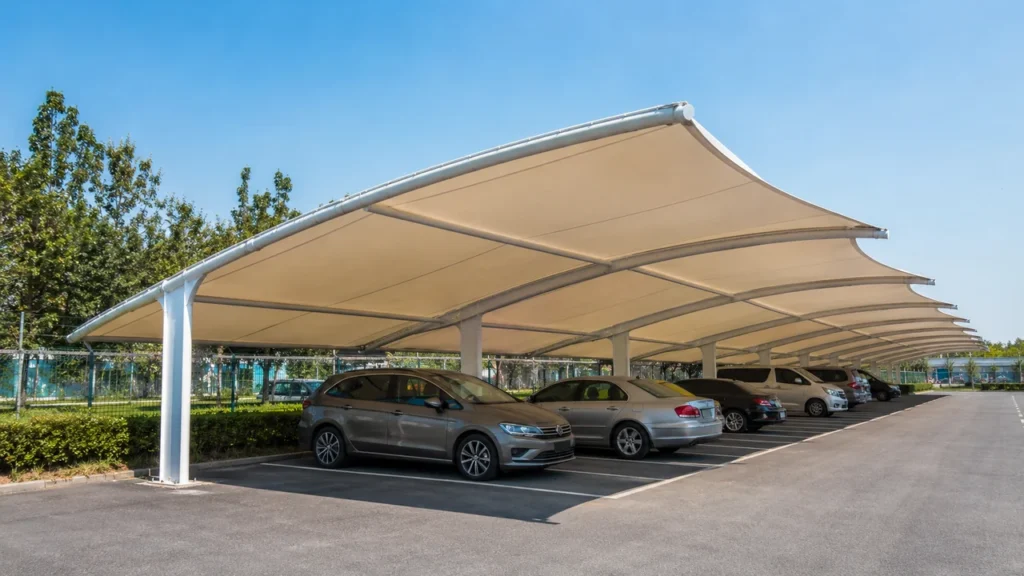
In membrane carport projects, column layout should follow the parking arrangement. The canopy must provide shade and weather protection without making daily parking difficult.
Before confirming the span and column bay, the project team should check the number of parking spaces, parking bay width, vehicle height, driveway width, turning route, drainage direction, lighting position and foundation location. If columns are placed too close to vehicle doors, drivers may have difficulty getting in and out of cars. If columns are too close to the driveway, reversing and turning may become inconvenient.
For commercial parking areas, hotels, office buildings, schools and public facilities, the most practical layout is usually one that protects the vehicles while keeping the parking area easy to use.
For this application, the membrane structure carport page provides a more specific product direction for parking shade projects.
Grandstand Projects: Span and Sightline Must Be Reviewed Together
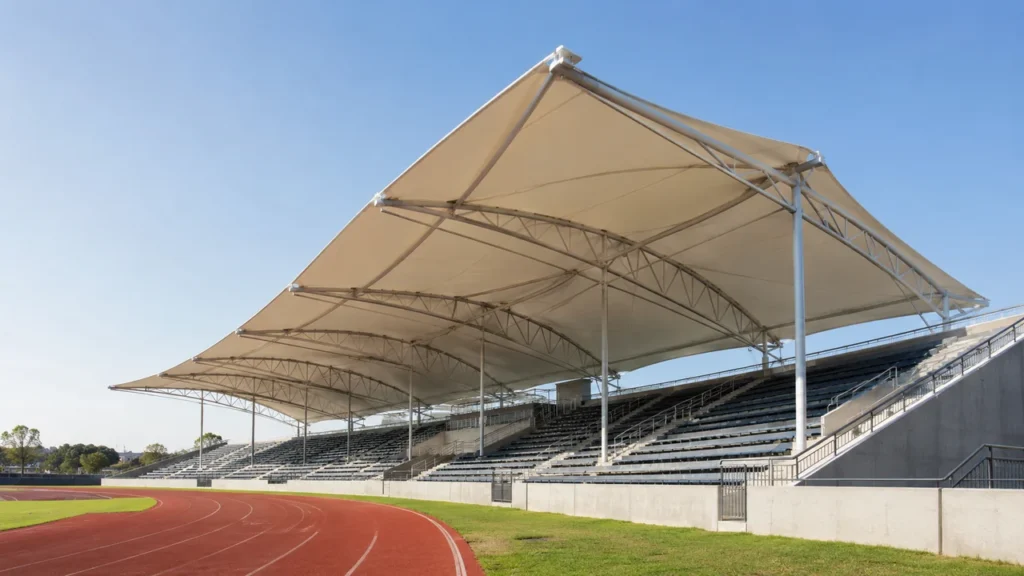
Grandstand and stadium membrane structures often require wider coverage and fewer visual obstructions. The canopy should protect spectators from sun and rain while keeping the view toward the field clear.
Column layout should be reviewed with seating rows, aisle positions, field direction, stair exits, lighting, speakers and existing grandstand structure. A support point placed in the wrong location may affect many seats, even if the overall structure is stable.
For this reason, sports canopy projects usually need earlier coordination between the owner, architect, contractor and membrane structure supplier. The structure should be reviewed not only from the outside appearance, but also from the audience’s viewing position.
For spectator seating applications, the grandstand membrane structures page can be used as a related product reference.
Toll Station Projects: Clearance and Safety Come First
Toll station canopies have stricter layout requirements because the structure must work around moving vehicles, toll booths, traffic islands, signs, lighting, cameras and maintenance access.
In this type of project, the span should be reviewed with lane quantity, lane width, heavy vehicle clearance, toll booth position and traffic flow. Column layout should maintain a safe distance from active lanes and should not block signs, cameras or driver visibility.
Drainage also needs careful planning. Rainwater should not be directed toward toll equipment, electrical areas or traffic lanes. Maintenance access for lights, signs and roof components should be considered before the canopy structure is finalized.
For transport infrastructure projects, the toll plaza canopies and toll station roof structures page gives a more focused application reference.
Existing Buildings Require Extra Layout Review
When a membrane canopy is added to an existing building, the span and column layout should be reviewed more carefully than in a new project. The supplier may need to work around existing walls, glass facades, doors, underground utilities, waterproofing layers, landscaping, signs and structural limitations.
A wall-connected canopy may look simple, but the building structure must be able to accept the connection load. A column-supported canopy may reduce load on the facade, but the ground must allow foundation work. A cantilevered structure may keep the entrance open, but it usually places higher demand on the steel frame and connection points.
For retrofit projects, site photos are helpful, but they are not enough. Basic dimensions, fixing conditions, available foundation positions and any known restrictions should be provided before quotation.
Information Needed Before Span and Column Layout Review
A practical quotation depends on practical project information. Even if final engineering drawings are not available, buyers can still prepare basic details for the first discussion.
| Information | Why It Is Needed |
|---|---|
| Project application | Confirms whether the structure is for a carport, entrance, toll station, grandstand, park, walkway or other use |
| Site dimensions | Helps review span, covered area, clear height and column spacing |
| Drawings or sketches | Shows building layout, facade position, support points and design intention |
| Site photos | Helps identify existing conditions, obstacles, access limits and installation environment |
| Project location | Affects wind, rain, snow, corrosion environment, material selection and shipping route |
| Required clearance | Important for vehicles, pedestrians, equipment, spectators or maintenance access |
| Foundation condition | Determines whether columns can be placed in the intended locations |
| Drainage requirement | Helps coordinate membrane slope, gutter position, downpipes and water discharge points |
| Supply scope | Clarifies whether the buyer needs membrane only, steel frame, accessories, drawings, packing or installation support |
Planning Mistakes That Often Cause Site Problems
Many membrane structure issues are not caused by the membrane material itself. They often come from incomplete early layout planning.
- Choosing the canopy shape before checking the real site dimensions.
- Requesting a large span without reviewing foundation conditions.
- Placing columns where vehicles, doors, pedestrians or equipment need clearance.
- Ignoring drainage until after the steel layout is already fixed.
- Copying a canopy design from another project with different site conditions.
- Comparing quotations without checking steel frame scope and support method.
- Not confirming whether accessories, component labels, packing or installation drawings are included.
- Treating membrane material selection separately from steel structure planning.
These mistakes can lead to redesign, delayed installation, unexpected cost changes or reduced usability after completion.
How to Prepare the First Layout Discussion
For the first discussion, buyers do not always need complete engineering drawings. A simple but clear information package is often enough for the supplier to understand the project direction.
Before sending an inquiry, it is useful to prepare answers to the following questions:
- What area should the canopy cover?
- What are the approximate length, width and height?
- Where can columns be placed?
- Are there doors, lanes, vehicles, seats, signs or equipment that must remain clear?
- Is the project located in a windy, rainy, snowy, coastal or high-sun-exposure area?
- Is the preferred structure open-span, repeated-bay, wall-mounted, column-supported or cantilevered?
- What membrane material or appearance is preferred?
- Does the buyer need membrane only, or a complete structure package?
Once these points are clear, the supplier can make a more useful early judgment about span, column position, material direction and quotation scope.
Conclusion
Span and column layout are not minor details in tensile membrane structures. They affect appearance, steel frame design, foundation, drainage, installation, cost and the way people or vehicles use the covered space after completion.
A good membrane structure is not simply a fabric roof. It is a coordinated system that includes membrane material, steel structure, support points, drainage, foundation, site use and installation logic.
Before requesting a quotation, buyers should prepare drawings, basic dimensions, site photos, project location, required clearance and application information. This allows the structure to be reviewed as a real project rather than a standard product.
For custom canopies, carports, toll stations, grandstands, public shade structures or other outdoor membrane applications, you can send drawings, dimensions and site requirements through the project inquiry page for a practical structure review and quotation discussion.