
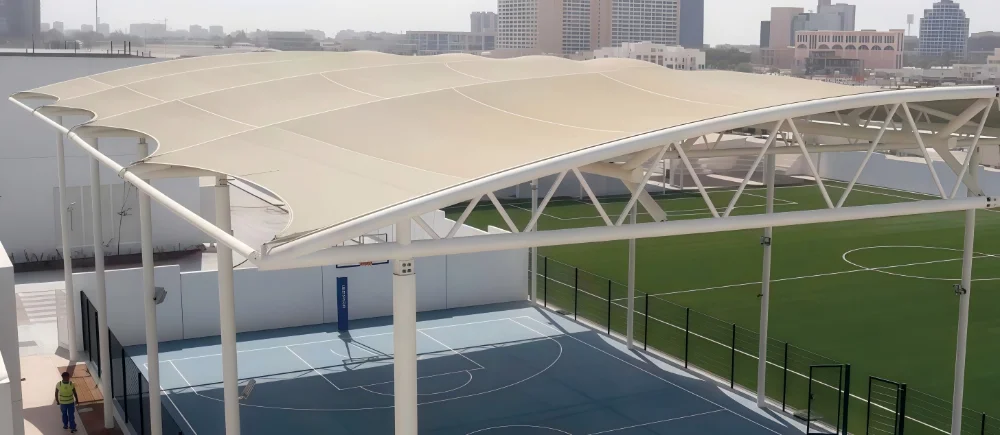


Choosing a tensile membrane structure manufacturer requires more than comparing roof photographs and square-meter prices. The supplier must be able to turn the project requirements into a defined package of engineering information, manufactured components and installation support.
We recommend evaluating suppliers through the documents and explanations they provide for your project. A general capability statement is useful background, but it should lead to evidence that matches the proposed structure and supply scope.

1. Establish Who Is Responsible for Each Part of the Work
A supplier may manufacture the membrane, fabricate the steel, coordinate specialist subcontractors or provide a combined package. None of these arrangements should be assumed from the company description alone.
Ask who performs the structural design, membrane patterning, steel fabrication, material procurement and final inspection. Where subcontractors are involved, establish who controls their work and remains responsible for delivery.
For overseas projects, clarify responsibility for local engineering review, approvals, foundations and installation. Supplier drawings should not be assumed to satisfy every local approval requirement without review.
2. Check the Questions Asked Before Quotation
A useful proposal should be based on more than a reference image and approximate covered area.
The supplier should establish the project location, use, dimensions, support restrictions, required clearances and available design criteria. Existing structures, drainage and installation access may also affect the proposal.
Missing information does not always prevent an initial estimate. It should, however, be recorded as an assumption, an exclusion or an item requiring confirmation.
A quotation with visible assumptions is easier to evaluate than a precise-looking price based on undisclosed conditions.
3. Request Evidence That Matches the Claim
| Supplier claim | Evidence to request | What to assess |
|---|---|---|
| Engineering capability | A relevant design-basis summary and sample drawing package | Whether geometry, loads, supports and responsibilities are clearly defined |
| Manufacturing control | An inspection plan and anonymized production records | Whether checks have methods, acceptance references and recorded results |
| Material traceability | Product identification and supporting material documents | Whether records correspond to the proposed material and supplied batch where applicable |
| Export experience | A sample packing list and component-marking arrangement | Whether delivered parts can be matched to installation drawings |
| Installation support | A defined support scope and example installation information | What the local contractor receives and what remains its responsibility |
Confidential project records can be anonymized. The purpose is to assess the supplier’s working method and relevant experience, rather than request another customer’s commercial information.
4. Evaluate Similar Projects by Their Constraints
Two roofs can look similar while presenting different engineering and installation demands.
When reviewing a reference, ask about the supplier’s actual role, the structural arrangement, installation conditions and scope delivered. A photograph alone does not show whether the company designed, manufactured or installed the structure.
For a rooftop canopy, relevant experience includes building interfaces and lifting access. For a grandstand, sightlines and support positions matter. For an ETFE cushion roof, ask about the system equipment and commissioning responsibilities.
Our project workflow for contractors explains how these requirements connect with fabrication and delivery.
5. Compare Quotations Line by Line
Before comparing totals, establish whether each proposal includes equivalent work.
- Specified membrane manufacturer, series and fabrication scope.
- Supporting steel and the basis used to define its scope.
- Cables, clamps, plates, bolts and other connection components.
- Corrosion-protection treatment and inspection requirements.
- Drainage, flashings and building interfaces.
- Engineering documents and approval responsibilities.
- Export packing, transport and delivery terms.
- Installation guidance, supervision or site installation.
- Warranty conditions and clearly listed exclusions.
If a proposal substitutes a material or changes the structural arrangement, request the difference in writing. A lower total should not conceal a change in the required performance or supply scope.
Our membrane structure cost guide explains the principal items that affect the quotation.
6. Review Inspection and Nonconformance Procedures
Ask how the supplier checks dimensions, connections, membrane fabrication and component identification. The inspection plan should identify the relevant acceptance basis and any agreed customer witness points.
Also ask what happens when an item fails inspection. The procedure should explain how the issue is recorded, corrected and rechecked before shipment.
For example, a record showing only that a connection was “checked” provides less assurance than one identifying the drawing revision, measured result and acceptance reference.
Our pre-shipment quality control guide identifies the main component groups to review.
7. Confirm How Changes and Site Questions Are Managed
Before ordering, agree how revised dimensions, material substitutions and drawing changes will be approved. The factory and installation team should work from the same authorized revision.
Installation support should also be defined. Establish the contact route, expected availability, documents supplied and arrangements for site attendance if required.
Where local contractors perform installation, clarify who reviews lifting arrangements, temporary works and site procedures. These responsibilities should appear in the agreed scope.
Make the Supplier Decision Against the Project Requirements
Mandatory requirements should be resolved before comparing commercial preferences. Unclear engineering responsibility, unsupported material substitutions or an undefined supply boundary should remain open issues until the supplier provides an acceptable response.
Once the technical scope is comparable, assess price, delivery, communication and support. This produces a more useful supplier comparison than selecting the lowest initial square-meter figure.
Order & Project Support
Send us your drawings, project location, required materials and expected supply scope. Include any inspection, documentation or local approval requirements so they can be addressed in the proposal.