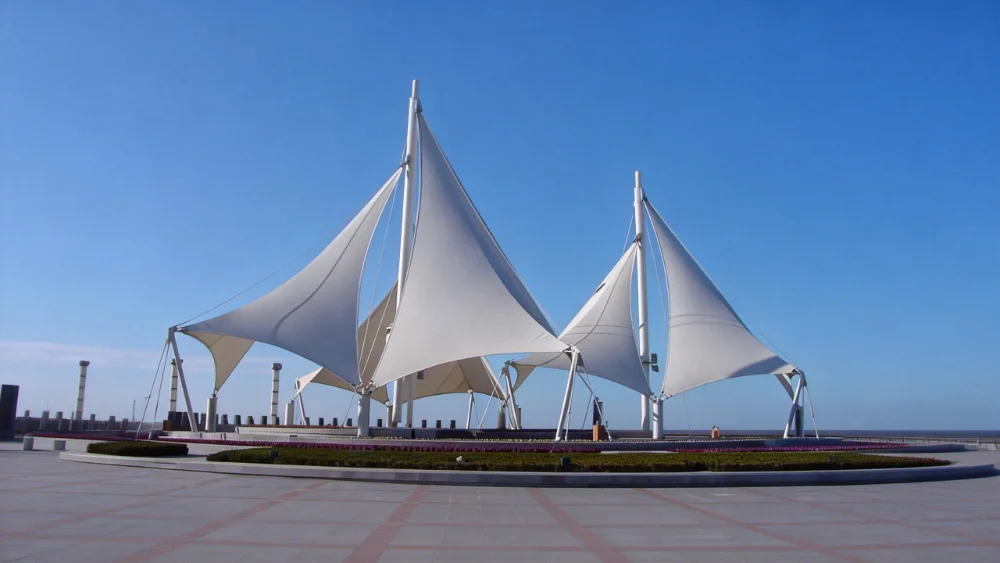
For most membrane structure projects, the first question from buyers is simple: how much does a tensile membrane structure cost?
The honest answer is that a tensile membrane structure cannot be priced accurately by area alone. Two projects may have the same covered square meters, but the final cost can be very different because of span, steel quantity, membrane material, wind load, foundation conditions, drainage design, fabrication complexity, shipping volume, and installation requirements.
A small car parking canopy, a large stadium shade, a toll plaza roof, and an ETFE architectural roof all belong to the membrane structure category, but their cost logic is not the same.
This guide explains the main factors that affect tensile membrane structure price and what information buyers should prepare before requesting a quotation.
1. Why There Is No Fixed Square-Meter Price
Many buyers start by asking for a price per square meter. This is understandable, but in membrane structure engineering, a square-meter price is only useful after the basic design conditions are clear.
A tensile membrane structure is not only fabric. It normally includes:
- Membrane material
- Steel support structure
- Connection hardware
- Cable or edge tensioning system
- Surface treatment
- Fabrication drawings
- Membrane cutting and welding
- Packing and container loading
- Installation guidance or site support
The membrane area is only one part of the cost. In some projects, the steel structure may represent a large part of the budget. In other projects, the membrane material, special shape, or installation condition may become the main cost driver.
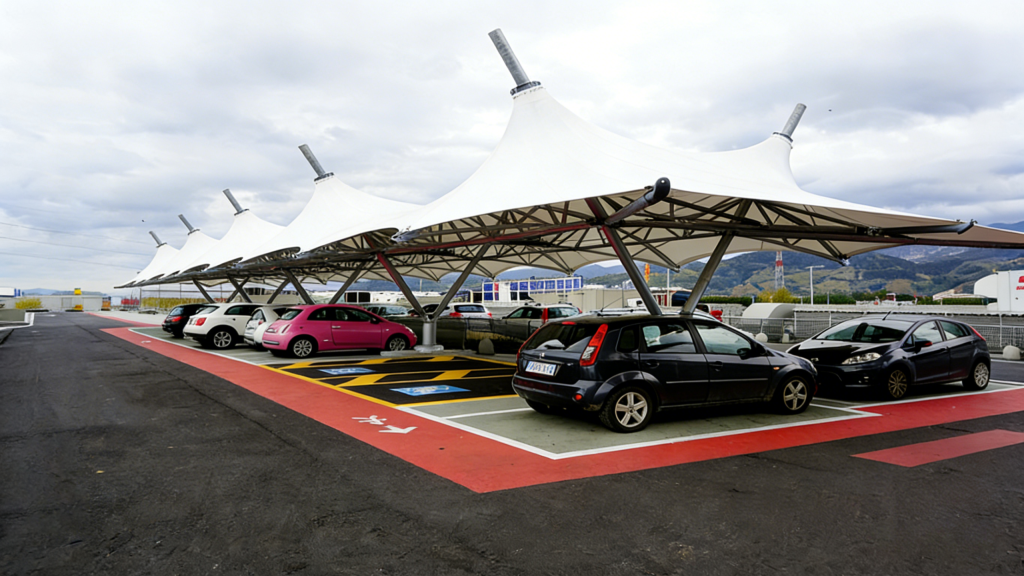
For example, a simple repeated parking canopy with standard spans is usually easier to estimate than a long-span custom architectural roof with curved steel, high wind load, and special membrane detailing.
That is why a reliable manufacturer should first review your project size, application, location, and structure requirements before giving a serious quotation.
2. Project Size and Covered Area
The total covered area is still an important cost factor. A larger project needs more membrane material, more steel, more fabrication time, more packing volume, and more installation work.
However, bigger area does not always mean higher unit cost. If the design uses repeated modules, standard column spacing, and efficient fabrication, the unit cost may become more economical as the project size increases.
For example, a large commercial parking canopy may use repeated bays, which can improve production efficiency. A small custom entrance canopy may have a higher unit cost because the design, steel detailing, and fabrication work are more specialized.
Before requesting a quote, prepare:
- Total covered area
- Length and width
- Approximate height
- Number of bays or modules
- Site plan if available
- Photos of the installation area
If your project is a parking area, you can also refer to our tensile membrane car parking canopy systems to see how parking layouts, steel support, membrane performance, and drainage are considered together.
3. Span and Structural Layout
Span is one of the biggest reasons why two membrane structures with similar area may have very different prices.
A short-span structure usually requires less steel and simpler support. A long-span structure often needs stronger steel members, larger foundations, more careful tensioning, and more detailed engineering coordination.
The following details affect the structural cost:
- Distance between columns
- Clear height requirement
- Cantilever length
- Roof shape
- Edge beam design
- Cable arrangement
- Wind load and snow load
- Foundation position
- Whether columns can be placed freely
In many commercial projects, buyers want fewer columns because open space looks cleaner and is easier to use. This is possible, but it usually increases the steel structure cost. The best solution is not always the minimum number of columns. The best solution is the layout that balances function, appearance, structure, and budget.
For early-stage budgeting, it is helpful to send a drawing or rough sketch. Even a simple hand drawing with dimensions can help the engineering team judge whether the span is practical.
4. Membrane Material Selection
The membrane material directly affects cost, appearance, service life, maintenance, light transmission, and weather resistance.
Common choices include PVDF-coated fabric, PTFE membrane, and ETFE systems.
PVDF Membrane
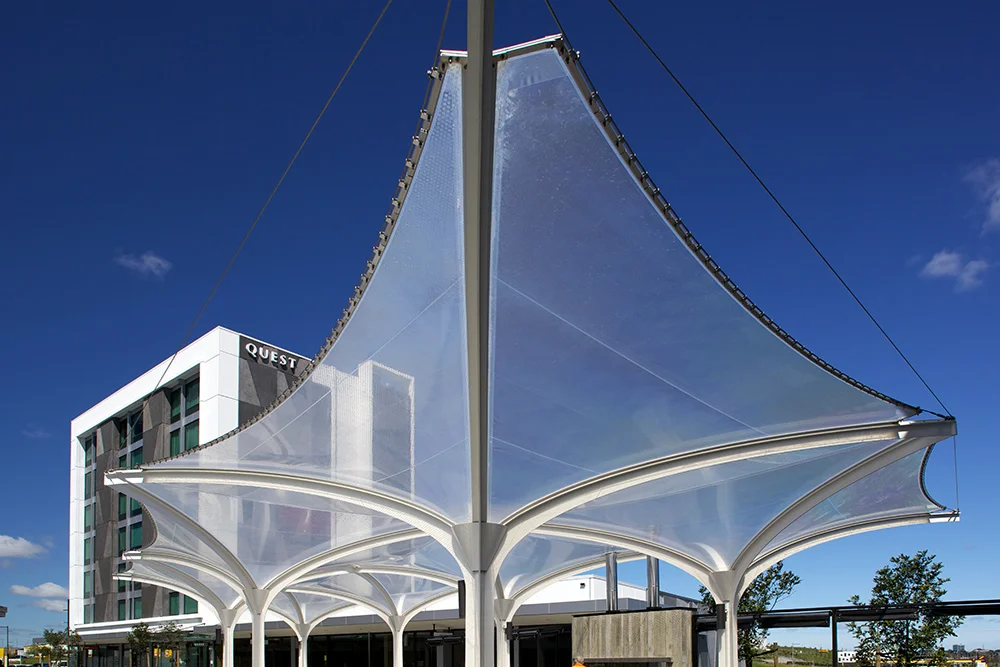
PVDF-coated fabric is widely used for carports, shade structures, walkway covers, entrance canopies, and many outdoor commercial projects. It offers a good balance between cost, flexibility, UV resistance, and appearance.
For many standard outdoor canopy projects, PVDF is a practical option.
PTFE Membrane
PTFE membrane is often selected for projects that require higher durability, stronger weather resistance, and better long-term performance. It is usually more expensive than standard PVDF fabric but may be suitable for demanding public, commercial, transport, or long-service-life projects.
ETFE System
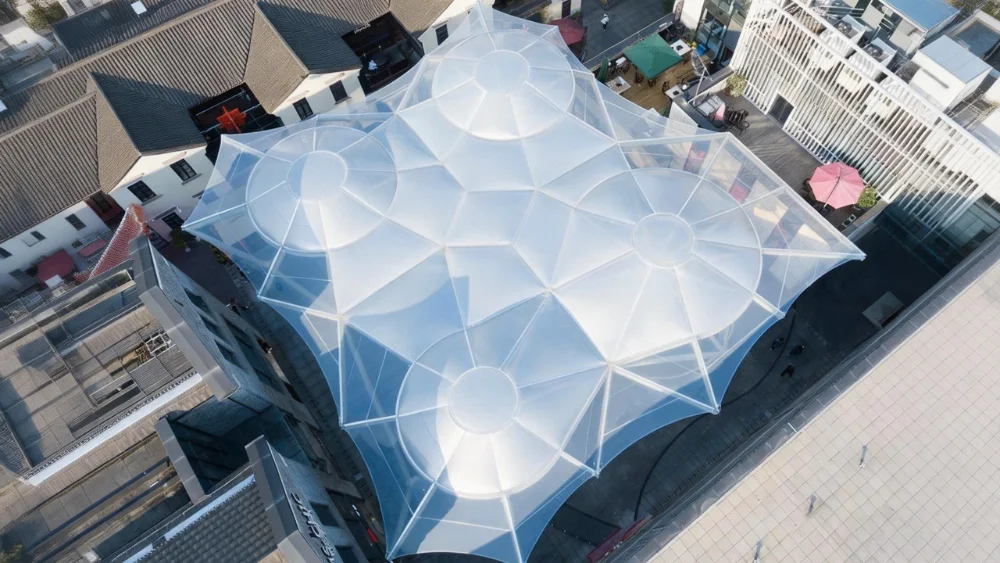
ETFE is different from standard fabric membrane. It is often used for lightweight transparent roofs, facades, atriums, skylights, public spaces, and special architectural projects. ETFE can provide high daylight transmission and a modern appearance, but the system design, aluminum or steel support, air cushion configuration, and installation requirements can make the cost structure very different from normal fabric canopies.
For projects that need transparent roofing or architectural enclosure, you can review our ETFE membrane structure solutions for roofs and facades.
5. Steel Structure and Surface Treatment
A tensile membrane structure depends on the steel support system. The membrane provides the lightweight roof surface, but the steel frame carries the main structural load and controls the final shape.
Steel cost is affected by:
- Steel grade and member size
- Structural span
- Column height
- Welding complexity
- Connection plates
- Surface treatment
- Corrosion resistance requirement
- Local climate
- Transportation size limits
For outdoor membrane buildings, corrosion protection is very important. Many parking canopies and outdoor shade structures use hot-dip galvanized steel frames or other anti-corrosion treatments. In coastal regions, industrial zones, or humid environments, stronger corrosion protection may be needed.
If the steel frame is under-designed, the project may look cheaper at first but create risk during installation or long-term use. If the steel frame is over-designed, the project may become unnecessarily expensive. The correct approach is engineering-based design according to the project location, span, load, and service environment.
For related technical information, you can read our article on steel structure for membrane buildings.
6. Wind Load, Snow Load, and Local Climate
Local climate has a direct effect on tensile membrane structure cost.
A project in a low-wind, warm region may need a different structural solution from a project in a coastal, snowy, or high-wind area. The membrane material, steel frame, connections, foundations, and installation details should all be considered according to real site conditions.
Important climate information includes:
- Basic wind speed
- Snow load
- Rainfall intensity
- Temperature range
- UV exposure
- Sand or dust
- Coastal corrosion
- Typhoon or storm risk
- Local building requirements
If the project location is not provided, the supplier can only make assumptions. This may lead to inaccurate pricing. For a more useful quotation, always provide the project country, city, and site environment.
7. Shape Complexity and Fabrication Difficulty
Tensile membrane structures are known for their flexible and elegant shapes. However, shape complexity can affect cost.
A simple repeated canopy is usually easier to fabricate and install. A complex double-curved roof, irregular boundary, special edge detail, or large architectural form requires more design time, more accurate membrane patterning, and more careful steel coordination.
Cost may increase when the project includes:
- Irregular plan shape
- Large curved steel members
- Special support nodes
- Complex membrane cutting
- Multiple membrane panels
- High visual finish requirement
- Unusual edge connection
- Hidden drainage or integrated lighting
- Difficult installation access
A good design should not only look attractive. It should also be practical to manufacture, pack, ship, assemble, and tension on site.
At Timi Membrane Structure, we organize membrane structure products by application so buyers can compare parking canopies, entrance covers, walkway shelters, shade structures, and custom fabric structures more efficiently. You can browse the full membrane structure product range for different application directions.
8. Drainage Design
Drainage is often overlooked during early budgeting, but it can affect both cost and performance.
A membrane surface must be shaped to guide rainwater properly. If the slope is not enough or the drainage direction is unclear, water may collect on the fabric surface or fall in the wrong area.
Drainage cost may depend on:
- Roof slope
- Low-point design
- Gutter requirement
- Downpipe position
- Hidden drainage details
- Rainfall intensity
- Site discharge conditions
- Edge height and architectural appearance
For parking canopies, walkway covers, and public shade structures, drainage must be coordinated with pedestrian routes, roadways, building entrances, and surrounding landscape. A low-cost design that ignores drainage may create maintenance problems later.
9. Foundation and Site Conditions
Foundation cost is sometimes outside the membrane supplier’s scope, but it still affects the total project budget.
Foundation design depends on:
- Soil condition
- Column reaction force
- Wind uplift
- Existing pavement
- Underground utilities
- Site access
- Local construction method
- Anchor bolt layout
If the site already has concrete pavement, it does not always mean the structure can be installed directly on it. The foundation must be checked according to the load and anchor requirements.
For overseas projects, foundation work is often handled by the local contractor, while the membrane structure manufacturer provides column base information, anchor bolt requirements, and related technical coordination.
10. Fabrication Drawings and Engineering Support
A low price is not useful if the project lacks clear drawings and fabrication control. Membrane structures require coordination between architectural shape, steel structure, membrane patterning, connection details, and installation sequence.
Professional engineering support may include:
- Drawing evaluation
- Structure option review
- Material recommendation
- Fabrication drawings
- Steel processing details
- Membrane cutting pattern
- Connection coordination
- Packing plan
- Installation guidance
Timi’s service process includes drawing evaluation, reference quotation, fabrication drawings, fabrication, container loading, and installation guide. This process helps buyers move from early project discussion to practical delivery with fewer uncertainties.
For public, commercial, and export projects, this type of support can reduce mistakes that may otherwise appear during production or installation.
11. Packing, Shipping, and Container Loading
For international buyers, shipping is part of the real project cost.
The size and weight of steel members, membrane rolls or panels, hardware, accessories, and packing method all affect container loading and freight cost. Long steel members may need special packing or container planning. Efficient packing can reduce wasted container space and lower shipping risk.
Shipping cost may be affected by:
- Total steel weight
- Longest steel member
- Number of containers
- Packing method
- Destination port
- Project schedule
- Whether installation tools or spare parts are included
Timi’s export support includes packing and container loading coordination, which is important for overseas membrane structure projects where missing parts or poor packing can cause expensive delays.
12. Installation Method and Site Support
Installation cost depends on project size, structure height, site condition, lifting equipment, crew experience, and whether technical supervision is required.
A membrane structure installation usually involves:
- Checking foundation and anchor bolts
- Assembling steel members
- Lifting and positioning the frame
- Installing connection hardware
- Unfolding membrane panels
- Protecting membrane surface during handling
- Tensioning membrane
- Adjusting edge details
- Checking drainage and finish quality
Large-span or public-facing projects may require more careful installation planning. Weather conditions can also affect the installation schedule because membrane tensioning should be managed under suitable site conditions.
For more details, see our article on on-site project management for membrane structures.
13. Application Type
Different applications have different cost priorities.
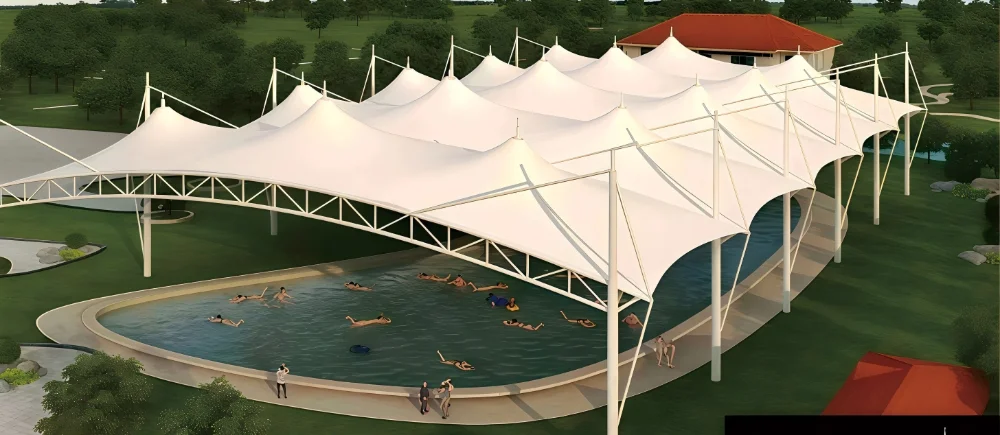
A parking canopy may focus on repeated layout, steel efficiency, UV protection, drainage, and vehicle movement. A toll plaza canopy may require larger span, traffic clearance, lighting coordination, and stronger public infrastructure performance. A stadium canopy may need bigger structural spans and higher architectural presentation. An ETFE roof may focus on transparency, air cushion system, and enclosure performance.
Common membrane structure applications include:
- Car parking canopies
- Toll plaza canopies
- Walkway covers
- Service station and EV charging canopies
- Entrance canopies
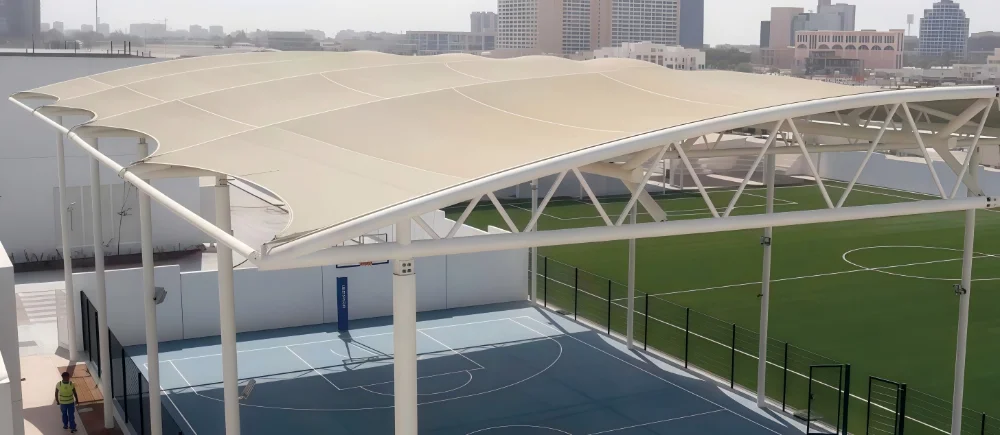
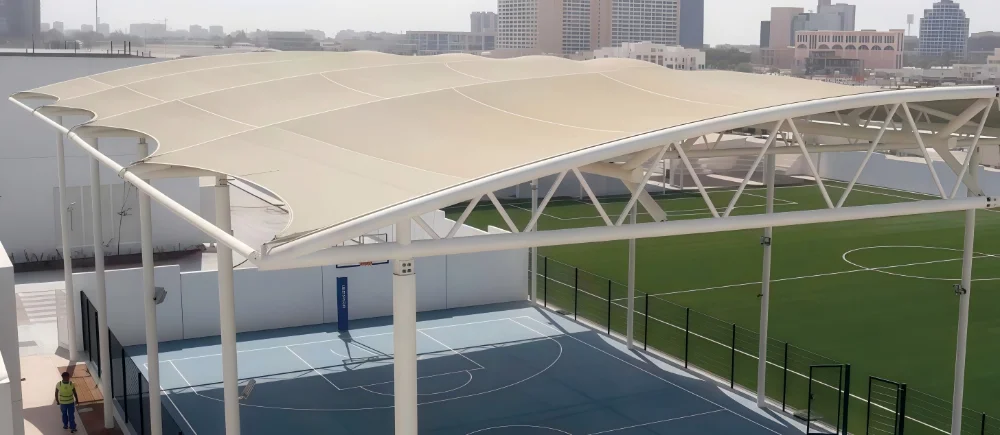
- Sports facility canopies
- Stadium shade structures
- Landscape shade structures
- ETFE roofs and facades
- Industrial membrane structures
You can explore different categories through our custom fabric structures and standard and modular shade structures pages.
14. Manufacturer Capability
The manufacturer’s capability also affects the real value of the quotation.
A cheaper quote may not include engineering review, proper material recommendation, fabrication drawings, quality control, export packing, or installation support. These missing parts can create extra cost later.
Before comparing prices, buyers should check whether the supplier can provide:
- Project-based design communication
- Membrane material selection
- Steel structure coordination
- Factory fabrication
- Quality inspection
- Export packing
- Container loading
- Installation guidance
- Technical response during the project
Timi Membrane Structure is a China-based manufacturer focused on tensile membrane architecture, steel support systems, and project-oriented fabrication for commercial, municipal, sports, transport, and landscape applications. The company works with buyers, contractors, and engineering teams from early concept discussion through structural coordination, material selection, factory production, and installation planning.
The company profile also shows a 40000㎡ factory area, 6000㎡ showroom, 100+ national patents, and 50+ served countries, which helps buyers understand the manufacturing and export background behind the quotation.
15. What Information Is Needed for an Accurate Quote?
To receive a practical quotation, prepare as much project information as possible.
Recommended information includes:
- Project name or application
- Country and city
- Site photos
- Layout drawing or sketch
- Covered area
- Length, width, and height
- Required span
- Preferred column position
- Wind load and snow load if available
- Preferred membrane material
- Steel surface treatment requirement
- Drainage requirement
- Foundation condition
- Installation schedule
- Destination port
- Whether installation guidance is needed
If drawings are not ready, send the project dimensions, photos, and a short description first. The supplier can review the basic direction and advise what else is needed.
So, How Much Does a Tensile Membrane Structure Cost?
The cost of a tensile membrane structure depends on the complete project conditions, not only the membrane area. The main cost factors are project size, span, membrane material, steel structure, surface treatment, wind and snow load, drainage, foundation condition, fabrication complexity, shipping, and installation support.
For early budgeting, a rough estimate may help. But for real procurement, a proper quotation should be based on drawings, site location, load requirements, material selection, and installation conditions.
The best way to control cost is not simply to choose the lowest price. It is to develop a structure that is efficient, buildable, durable, and suitable for the actual project site.
Request a Project-Based Quotation
If you are planning a tensile membrane structure project, send us your project scope, dimensions, application scenario, location, drawings, and preferred material. Our team can help review the structure option, material direction, fabrication requirements, and quotation details for a practical next step.
Request a Quote or browse our membrane structure product range to compare suitable systems for your project.